Engine room 3D laser scanning survey during a Vietnam port call
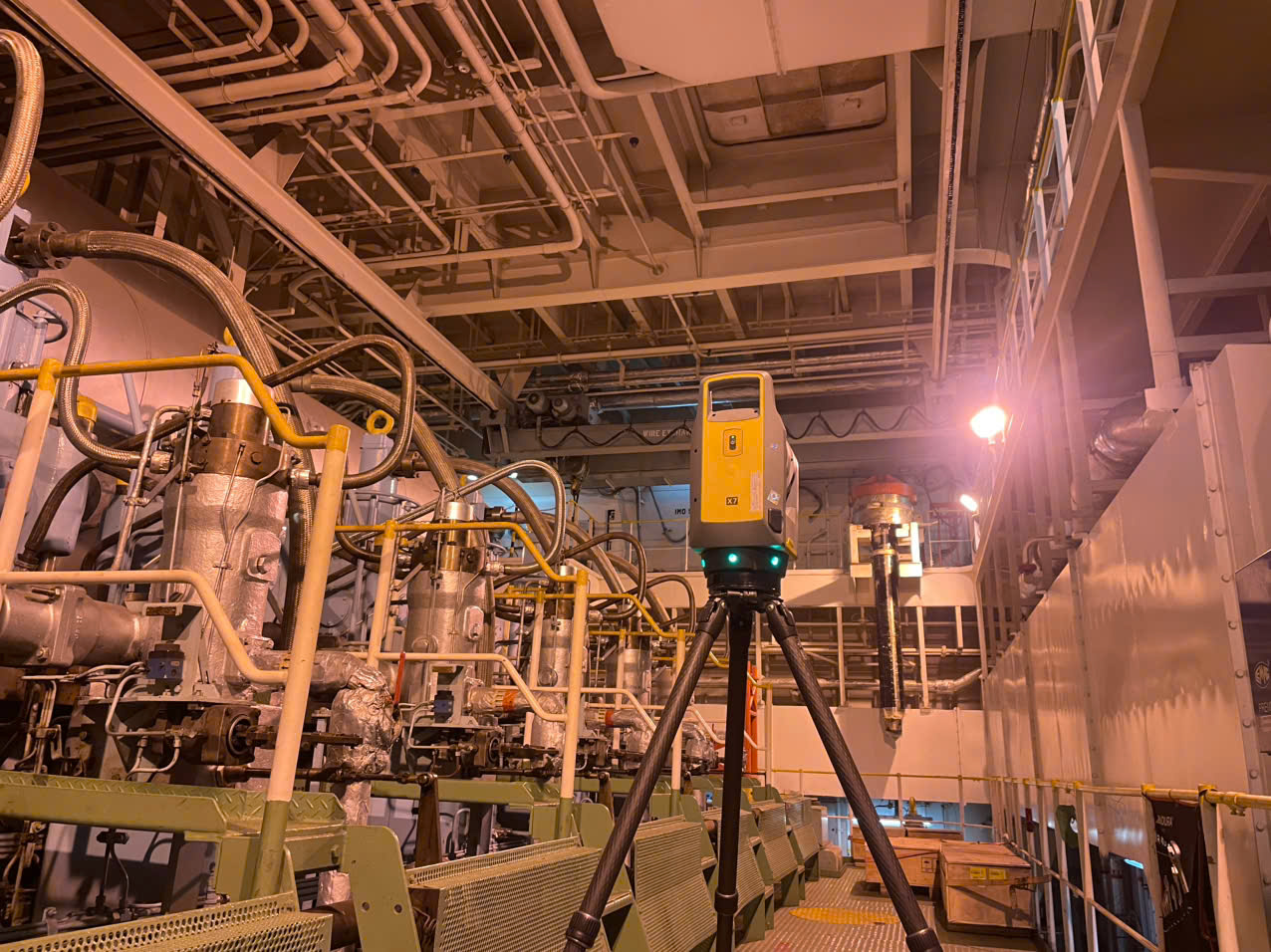
Summary: 3 key points
- 01
A ship calling at a Vietnamese port is usually alongside for only a few hours, and an engine room survey has almost no room for a second attempt. A missed area can mean a dimensional error or a clash between the new system and existing equipment.
- 02
VMTS has surveyed over 100 vessels at Vietnamese ports. One point of contact coordinates the local agent, boarding paperwork, scanning equipment and data checks, so the shipowner does not have to manage the port process directly.
- 03
Within a few days of the survey, the retrofit design team overseas receives a registered point cloud ready to work with. VMTS only needs the vessel name and the local agent’s contact details to get started.
What is an engine room 3D laser scanning survey during a Vietnam port call? An engine room 3D laser scanning survey during a Vietnam port call captures a retrofit-ready point cloud while the vessel is alongside for cargo, bunkering or other port operations. VMTS has surveyed over 100 vessels at Vietnamese ports, coordinating the local agent, boarding formalities and on-board scanning so shipowners and technical managers based overseas receive a registered point cloud within a few days.
For retrofit projects on ships already in service, an accurate survey of the engine room and adjacent technical spaces is one of the most important steps in the design process, and one of the steps with the least room for error. A vessel calling at a Vietnamese port is typically alongside only long enough to discharge cargo, take on bunkers or complete other port operations. Within that window, the survey team has to complete boarding formalities, reach the technical spaces, scan the engine room, check the data is complete, and leave the vessel before it continues its voyage. VMTS (VMT Solutions Co., LTD), a Scan-to-BIM provider based in Ho Chi Minh City serving the DACH market, organizes this process end to end for shipowners and technical managers who are not based in Vietnam.
Why do retrofit teams need an engine room point cloud?
Retrofit design teams need an accurate point cloud of the engine room and technical spaces to check clearances and plan the new installation against what is actually on board, not what the original drawings show. Engine rooms are dense and difficult to survey by hand: multiple deck levels, crossing pipe runs, high equipment density and areas that are hard to reach. Manual measurement or photographs alone rarely give the design team enough data to evaluate installation space with confidence.
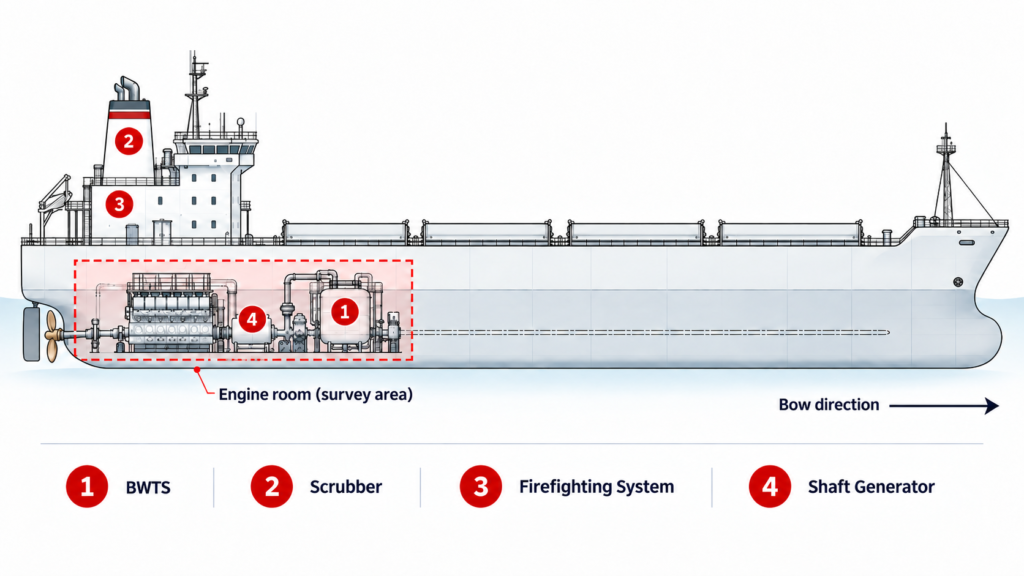
A 3D laser scanning survey captures the geometry, position and spatial relationship of the existing equipment in one pass. The resulting point cloud becomes the reference for design, clash detection, equipment layout and construction planning for the retrofit. Typical retrofit scopes include:
- BWTS: Ballast Water Treatment System installation
- Scrubber: Exhaust Gas Cleaning System or scrubber retrofit
- Firefighting system: retrofit of fixed firefighting equipment
- Shaft generator: new installation or upgrade
- Supporting piping, equipment and structural elements
- Other conversion or new-installation work inside the engine room
Why is the port call window the hardest part of the survey?
The hardest part of a ship survey is rarely the scanning equipment. Many providers own a 3D scanner, but few have experience surveying on board a working vessel under a fixed port call window. A marine scanning project succeeds or fails on the survey team’s ability to organize around the schedule and react to conditions that change without notice.
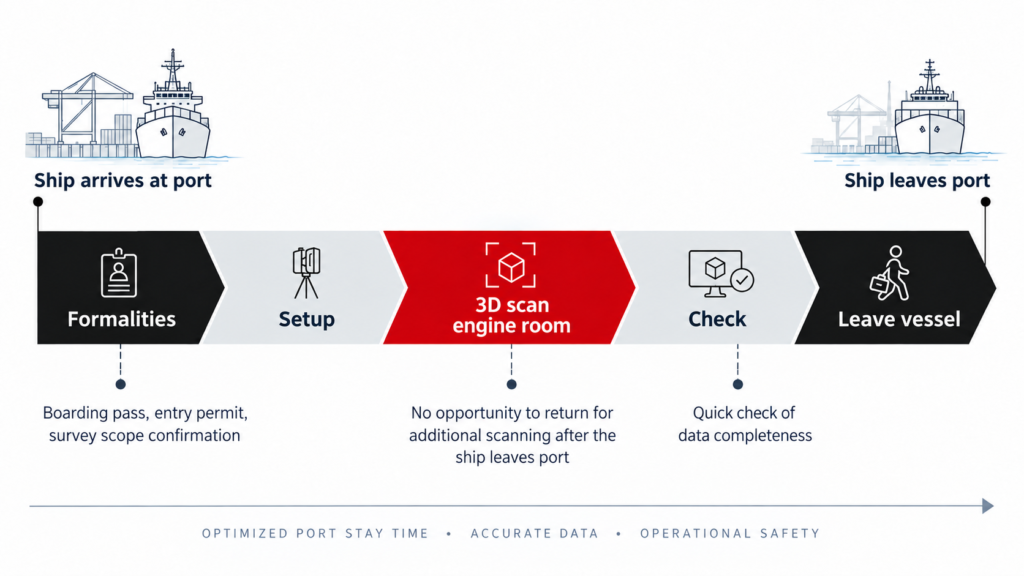
A survey team working on this kind of schedule has to plan for:
- A vessel schedule that can change at short notice, or a ship arriving later than planned
- A shortened berthing time
- A fast turnaround on entry permits and boarding passes
- A survey scope that may only be confirmed once the team is on board
- An engine room that may still be operating during the survey
- No opportunity to return for additional scanning once the ship has sailed
What happens in the retrofit design if survey data is incomplete?
A survey team without marine experience can miss areas that only become apparent once the design work is underway, and a small gap in coverage can affect the entire downstream process:
| Survey risk | Effect on the retrofit design |
|---|---|
| Point cloud missing an area | Dimensional errors in the design |
| Insufficient data around existing equipment | Clash between the new system and existing equipment |
| No option to return for additional scanning | Rework at the workshop and on board, adding cost and time |
So the goal is not only to finish scanning before the ship sails. The survey team has to know which areas to prioritize, how to place scan positions, and how to check the data on site, so the point cloud is complete and usable from the start.
How does VMTS organize a ship survey at a Vietnamese port?
VMTS has surveyed over 100 vessels at ports across Vietnam. Experience across BWTS, scrubber, firefighting system and shaft generator retrofit projects has shaped a process built around both the technical requirements and the time pressure of a port call. After receiving the vessel name and the local agent’s contact details, VMTS works directly with the agent through the following sequence:
- Confirm the vessel’s expected schedule
- Clarify the survey scope and objectives
- Prepare the boarding documentation
- Assign the survey engineers and 3D laser scanning equipment
- Track any changes to the port call schedule
- Carry out the survey as soon as boarding is permitted
- Check data completeness on board before leaving the vessel
- Register, clean and quality-check the point cloud
- Deliver the data in the File format requested
The shipowner does not need to travel to Vietnam or manage the port formalities directly. The entire process runs through a single point of contact, with updates throughout.
On-site images from the engine room
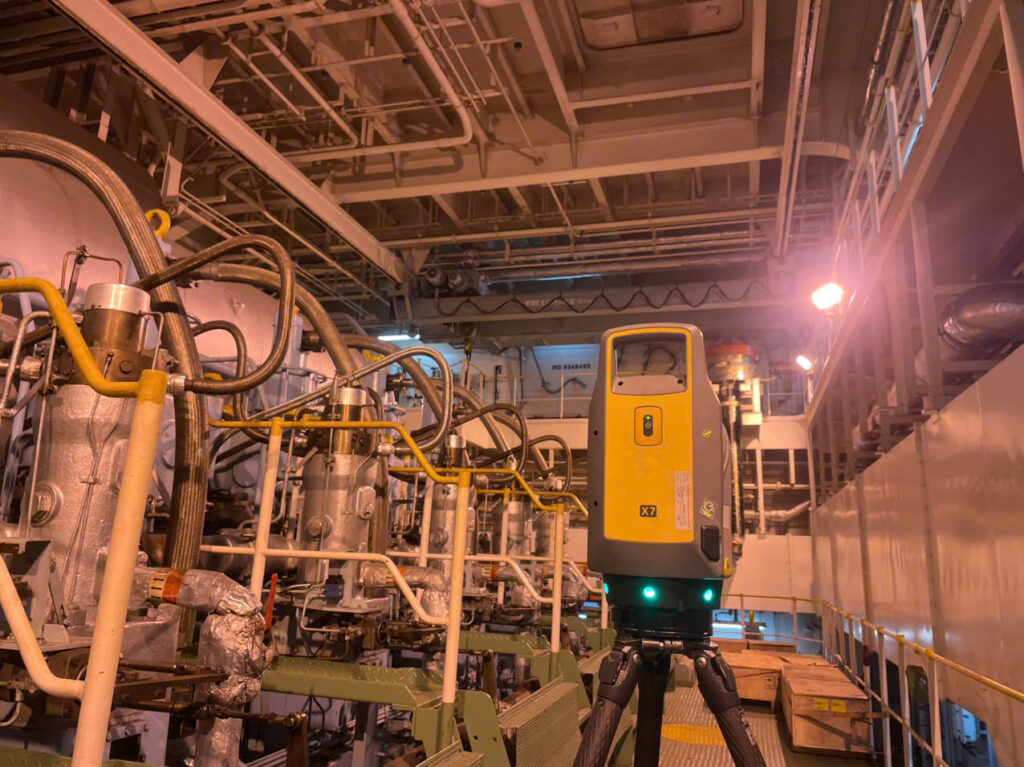
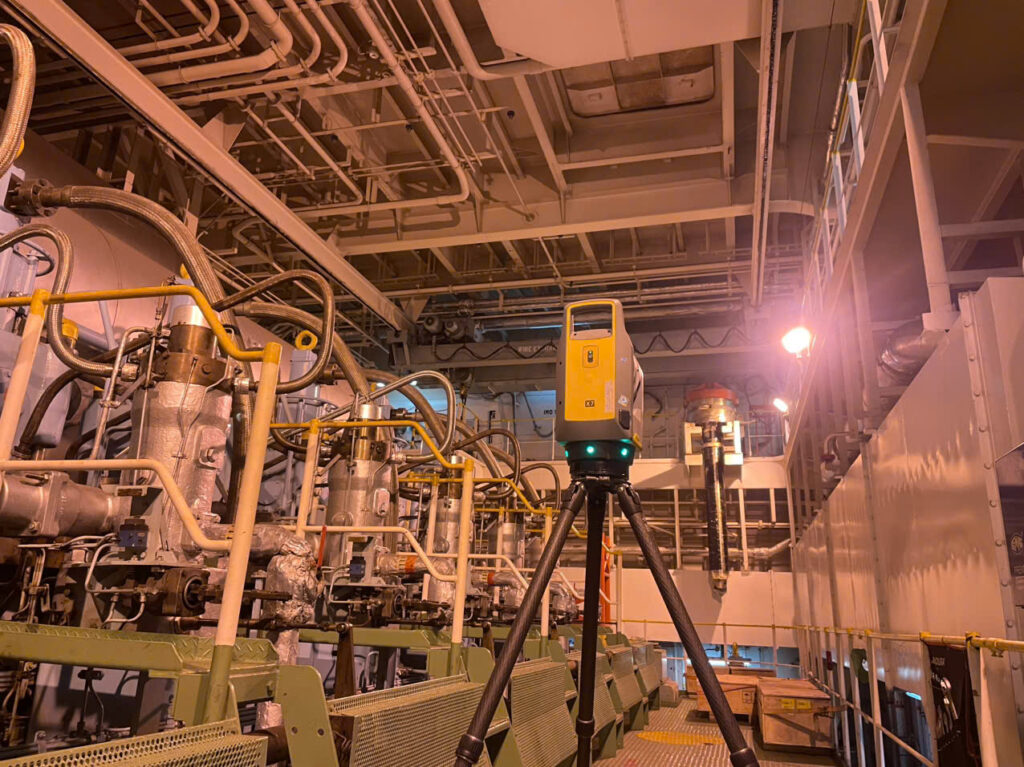
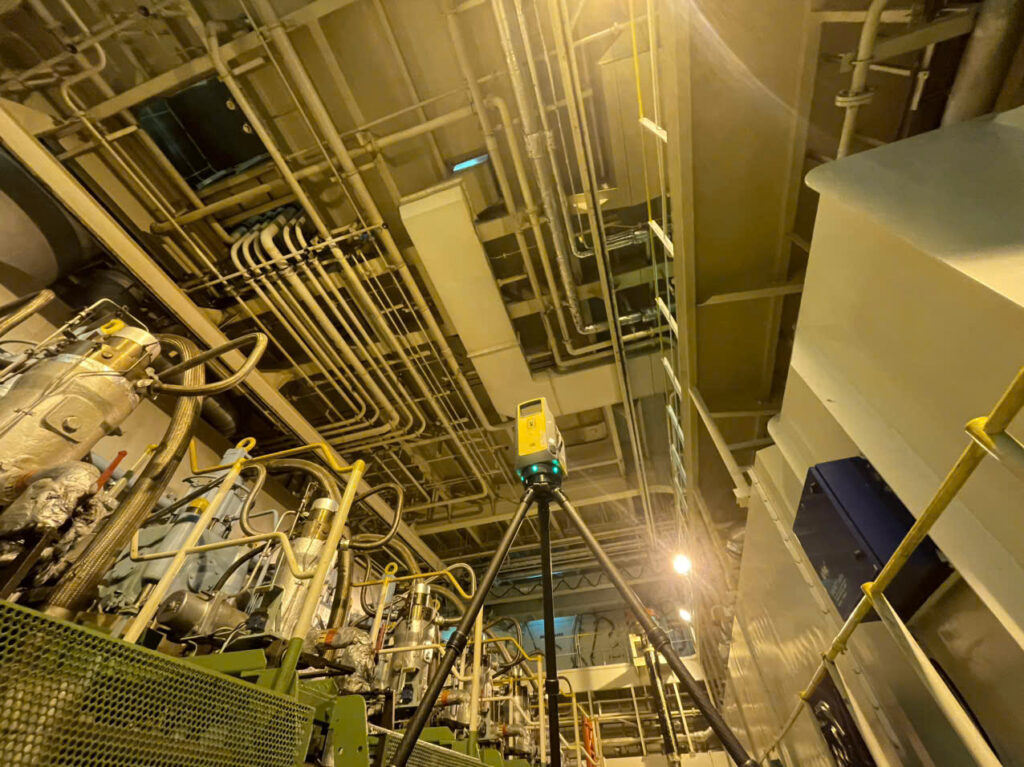
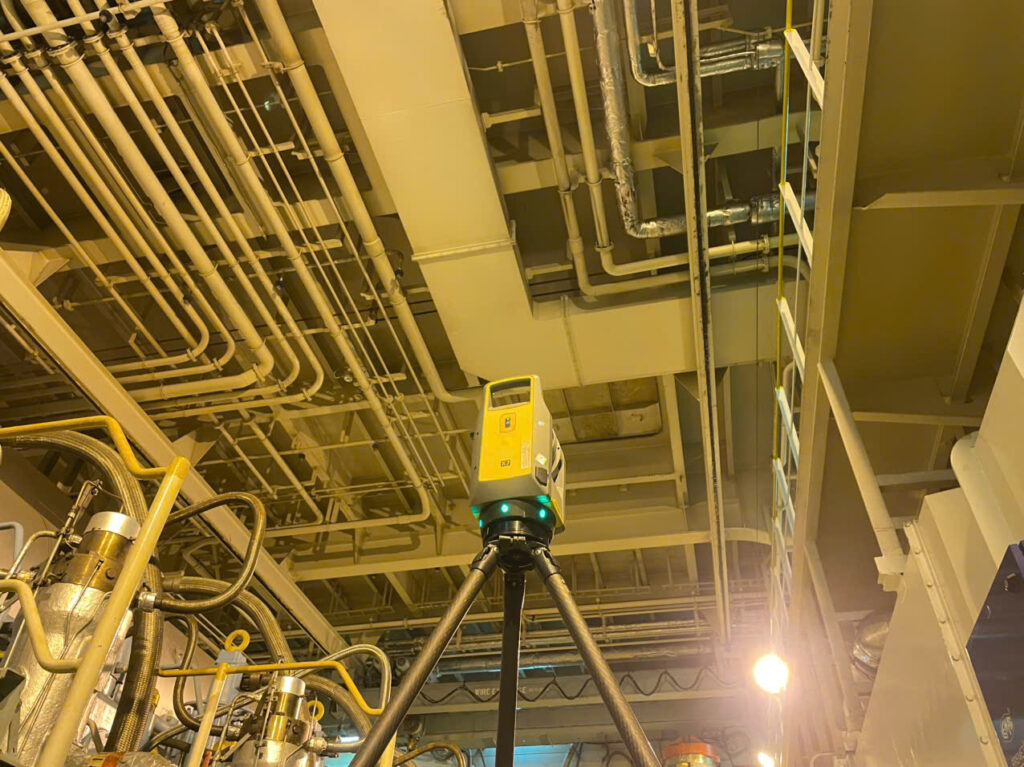
The 3D laser scanner at several positions in the engine room while the vessel is alongside at a Vietnamese port (VMTS).
What do we receive after the engine room survey?
Within a few days of survey completion, the client receives a registered, checked point cloud ready for the retrofit design process. Depending on the project, VMTS can continue to support with:
- Point cloud processing and quality control
- Dimension and section extraction
- As-built 3D modeling
- Conversion of the point cloud into a CAD or BIM model
- Modeling of the engine room, equipment, piping and structure
- Data preparation for clash detection
- Remote coordination with the retrofit design team
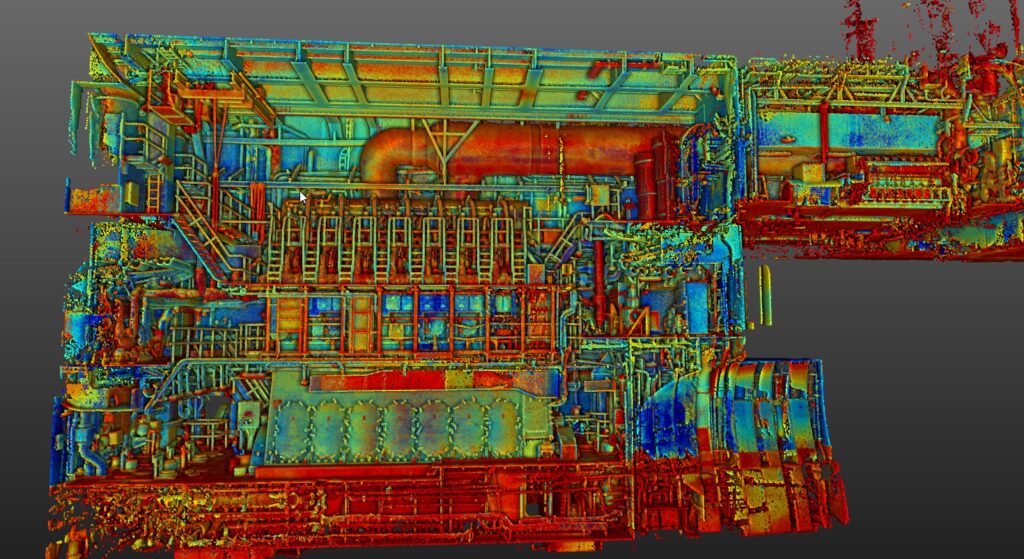
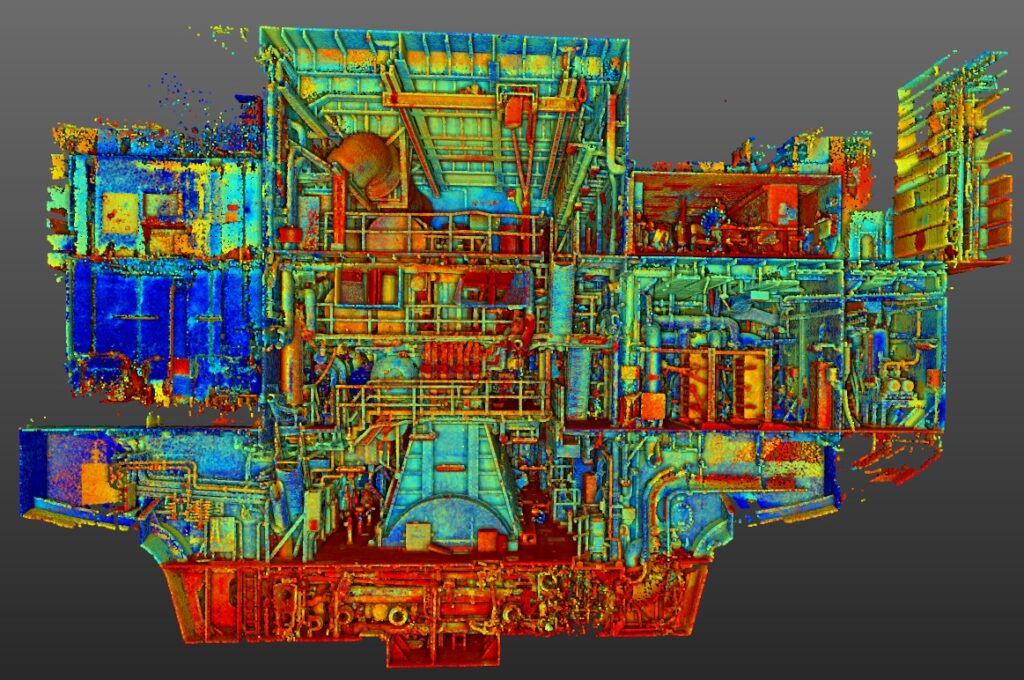
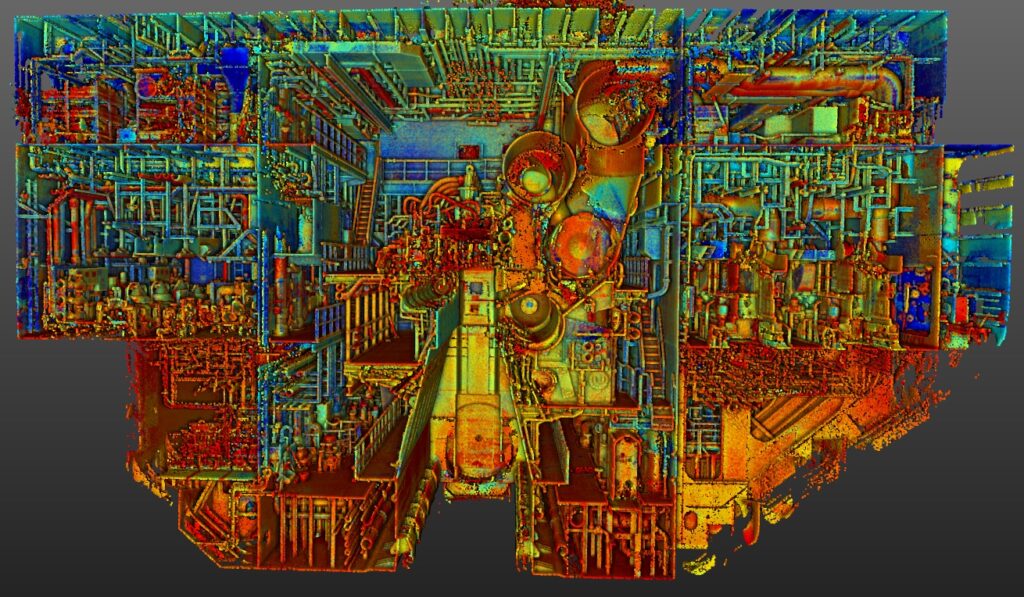
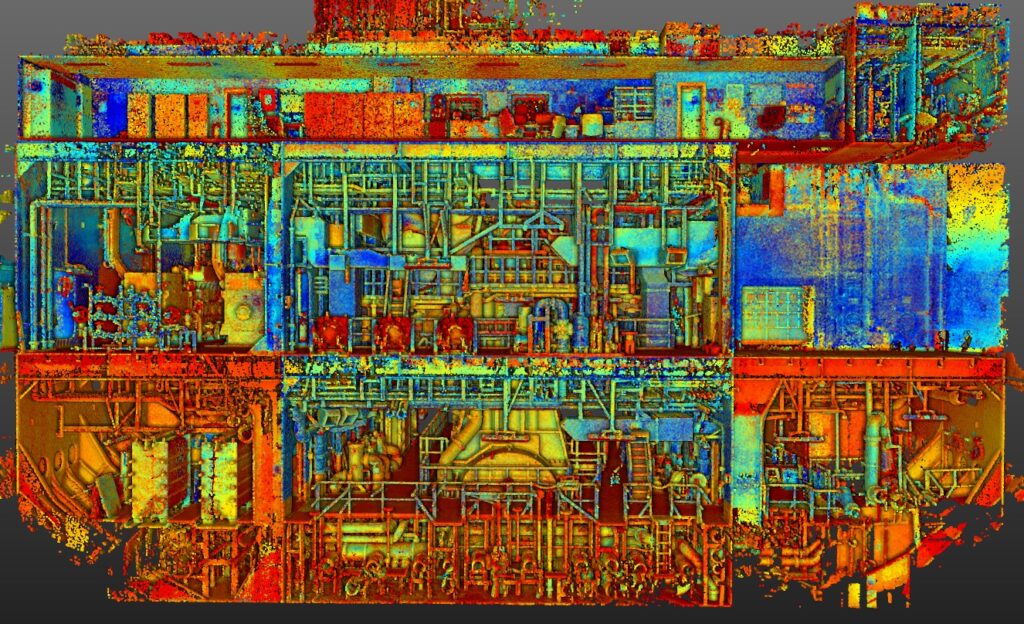
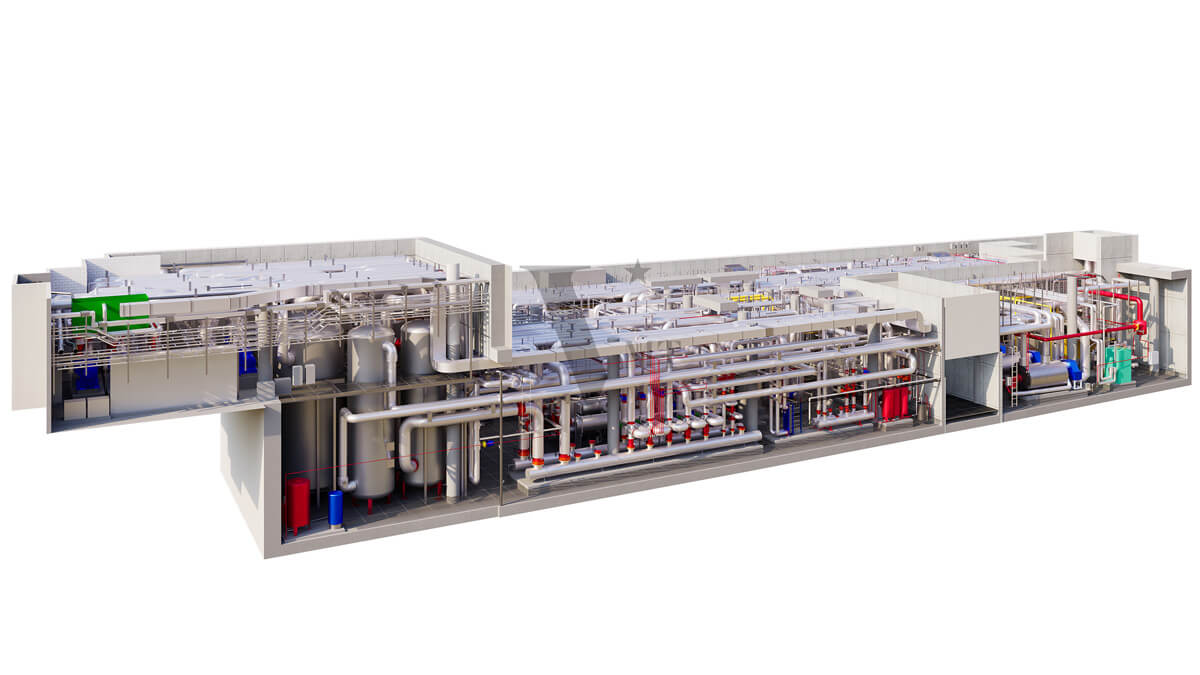
Registered engine room point clouds from two VMTS vessel survey projects.
VMTS has completed over 2,500 projects across 3D laser scanning and Scan to BIM. A team of over 100 specialists can deliver data as native Files in Revit, Archicad, Allplan or Vectorworks when a project calls for a modeled deliverable. See the Scan to BIM service page for scope and delivery details, or the guide to LOD 100 to 400 in BIM for how the required level of detail is defined for a retrofit model. For another marine project, see 3D laser scanning of marine vessels for EGCS retrofit applications. For the full workflow from point cloud to model, see Scan-to-BIM: the complete professional guide.
VMTS difference
Point cloud verification before modeling begins
Every dataset that reaches VMTS goes through a source data check performed by Geomatikers before the first wall is modeled. The QA/QC workflow has defined checkpoints, and when a project needs a modeled deliverable, Files are handed over as native Revit, Archicad, Allplan or Vectorworks models, without a dependency on IFC. Clients receive a quotation within 24 hours of sending survey requirements.
This is VMTS in practice: “You scan, we support all downstream services, from point clouds to native BIM models.” For a ship survey, that means the shipowner does not have to manage the port, the formalities or the data directly, and receives a point cloud that is ready for the design team to use.
Why survey the engine room now, at the Vietnamese port, instead of waiting?
Surveying the ship as soon as it calls at a Vietnamese port means the retrofit design team receives usable data sooner and can plan the project with more certainty. Many owners wait for the vessel to reach a familiar port, or to return to Europe, to organize the survey themselves, and that wait can delay the design process by weeks or months. If the vessel is already scheduled to call at a Vietnamese port, VMTS can organize the survey directly there. This approach fits particularly well when:
- The design team is based in Europe, Singapore, Japan or elsewhere
- The vessel’s berthing time is short
- The shipowner does not want to send an engineer to Vietnam
- The retrofit design needs an accurate point cloud to start early
- A return visit for additional scanning is unlikely to be possible
What do we send to VMTS to start a ship survey?
Two pieces of information are enough to begin. VMTS handles the rest of the process and keeps the client updated throughout.
| You send | VMTS handles |
|---|---|
| Vessel name | Confirming the schedule, survey scope and boarding documentation |
| Contact details of the local agent handling the ship’s formalities | Coordinating directly with the agent, tracking schedule changes, running the survey and delivering the point cloud |
There is no need to manage the port process directly. VMTS keeps the client updated throughout and reaches out directly if any additional information is needed.
Frequently asked questions about engine room 3D laser scanning surveys
What does an engine room 3D laser scanning survey include?
The survey captures the engine room and adjacent technical spaces as a point cloud using a 3D laser scanner, recording equipment, piping, decks and structure. The point cloud shows the true position and dimensions of the existing installation, so the retrofit design team can check clearances and clash risk before fabrication starts.
What does VMTS need from us to schedule a ship survey in Vietnam?
VMTS needs the vessel name and the contact details of the local agent handling the ship’s formalities at that port. VMTS then works directly with the agent to confirm the schedule, prepare the boarding paperwork, arrange the survey team and organize the remaining steps.
Can the engine room be scanned while it is still running?
Yes. The engine room can still be operating during the survey, so the survey team prioritizes the required areas, plans scan positions accordingly, and checks data completeness before leaving the vessel, since returning for additional scanning is rarely possible once the ship has sailed.
How long after the survey do we receive the point cloud?
VMTS typically delivers a registered, cleaned and quality-checked point cloud within a few days of survey completion. The exact timeline depends on the scope, the number of scan positions and the File format requested for delivery.
Can VMTS turn the point cloud into a CAD or BIM model of the engine room?
Yes. Depending on the project, VMTS can convert the point cloud into a CAD or BIM model, model the engine room, equipment, piping and structure, extract dimensions and sections, and prepare data for clash detection. Native File delivery in Revit, Archicad, Allplan or Vectorworks is available when the project requires it.
Working with VMTS
Is your vessel calling at a Vietnamese port? Just send us the vessel name and the agent’s contact details
The time a ship spends alongside for cargo or bunkering can be used to complete the survey, so the retrofit design team can start sooner. When convenient, send the vessel name and the local agent’s contact details. We are glad to discuss how to organize a 3D laser scanning survey in Vietnam for your project.
Nguyen Huynh (Rainer)

About the Author:
Nguyen Huynh (Rainer) is Managing Director at VMT Solutions, specializing in Point Cloud to BIM workflows for surveying, planning, and engineering offices. He focuses on precise BIM models, clearly defined quality standards, and long-term technical partnerships.
Share This Story!
Related Posts



Recent Posts




We are proud to have
satisfied customers.

 Gerd Gindullis, Lecturer for digital as-built data capture at Aachen University of Applied Sciences, TerraMeta 3D Laser Service
 Stefan Schramm, Architekt Stefan Schramm
„Your plans are perfect; I’ve never seen anything like this before. These are drawings of the highest quality, I must say. I want to express my sincere thanks once again for your work.“
 Endre Szokolai, Digitalplan-Szokolai
VMT modeled a large industrial building in 3D for our research project. We provided DWG plans to VMT, and they delivered a highly detailed model, including the building envelope, interior walls, openings, and stairs. We had previously contracted a German company for the same object, but unfortunately, it didn’t work out. I was relieved and pleased that VMT handled it so reliably. Thank you for the excellent work and the truly fair price!

Very reliable company, courteous staff, and top-quality work. Our plans were created quickly and accurately. Thank you for that. Highly recommended.
Excellent advice and high 3D modeling quality at a great price-performance ratio… What more could you want? I can highly recommend them…